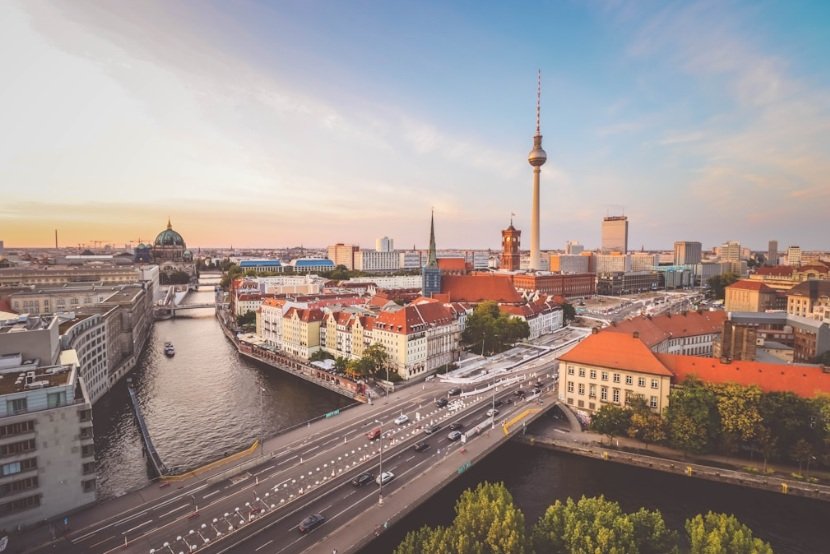

It is said that Paris is always beautiful and Rome is eternal. Berlin, on the other hand, is… honest. This city does not try to seduce you with makeup. Its beauty is raw, sometimes difficult, but that is exactly why it is magnetic. Most tourists limit themselves to a photo at the Brandenburg Gate and a walk along the colorful remains of the Wall at the East Side Gallery. However, the true history of the German capital is hidden in the details that are easy to miss if you don’t know where to look.
To truly understand Berlin, you need to stop looking for the perfect postcard and start reading the scars that history has left on its streets. Here is a guide to what really defines the character of this city.
The void that screams louder than monuments
At Bebelplatz, surrounded by the elegant buildings of the Opera and Humboldt University, it is easy to miss one of the most moving memorials in Europe. It is not a statue or an obelisk. It is a glass pane in the pavement.
If you look through it, you will see an underground room with empty white shelves. This is the “Library,” a memorial commemorating the infamous Nazi book burning in 1933. The shelf space is enough for the 20,000 volumes that were burned there. This void makes a bigger impression than any dramatic sculpture. It reminds us that in Berlin, the absence of something is often more important than its presence.
A scar on the ground
The East Side Gallery, with its colorful graffiti, is a pop culture icon. But if you want to understand what the Berlin Wall really was, you have to look down. The Wall wasn’t just a wall; it was a deadly system, a “death strip.”
In many places in the center, the original path of the Wall is marked by a double line of cobblestones in the ground. It cuts across streets, squares, and even modern buildings. It is a scar that divided families and worlds. Realizing that you are standing in a spot where, just a few decades ago, you could have been shot simply for being there, completely changes the perspective of your walk.
Bullets in museums and the man in the hat
Berlin is a city of contrasts, and Museum Island is the best proof of this. Here you will find temples of art holding treasures like the bust of Nefertiti. But take a close look at the columns and facades of the buildings. Many of them still bear the marks of bullets and shrapnel from the battle in 1945.
They were not removed during restoration on purpose. The architecture here is meant to be a witness to history, not just a pretty background. And while waiting at a traffic light, look at the red or green figure. If you see a little man with a hat, you are looking at the Ampelmann. It is one of the few symbols of the former East Germany (GDR) that survived reunification and became a cult object. It is a small detail that tells the story of “Ostalgie”—nostalgia for certain aspects of life in the East.
The best way to connect the dots
Berlin is vast and complex. Trying to understand it in fragments often ends in confusion. To weave the history of Prussian kings, Nazi terror, and the absurdity of the Cold War into a coherent story, it is worth listening to someone who can narrate the city.
For travelers who value the intellectual quality of their visit, the Welcome to Berlin tour is the ideal introduction.
These tours operate on the “Pay What You Wish” model. It is a fair and transparent system: you don’t buy blindly. You join a walk with a passionate local expert, and at the end, you decide the value of the experience yourself. This guarantees that the guides always give their best, offering a vivid narrative instead of reciting dates from memory.
If you are interested in other topics, you can find the full offer here: ? Tours in Berlin: https://freewalkingtour.com/berlin/
Berlin is not a city to just “see.” It is a city to experience and understand. It is worth doing it in good company.