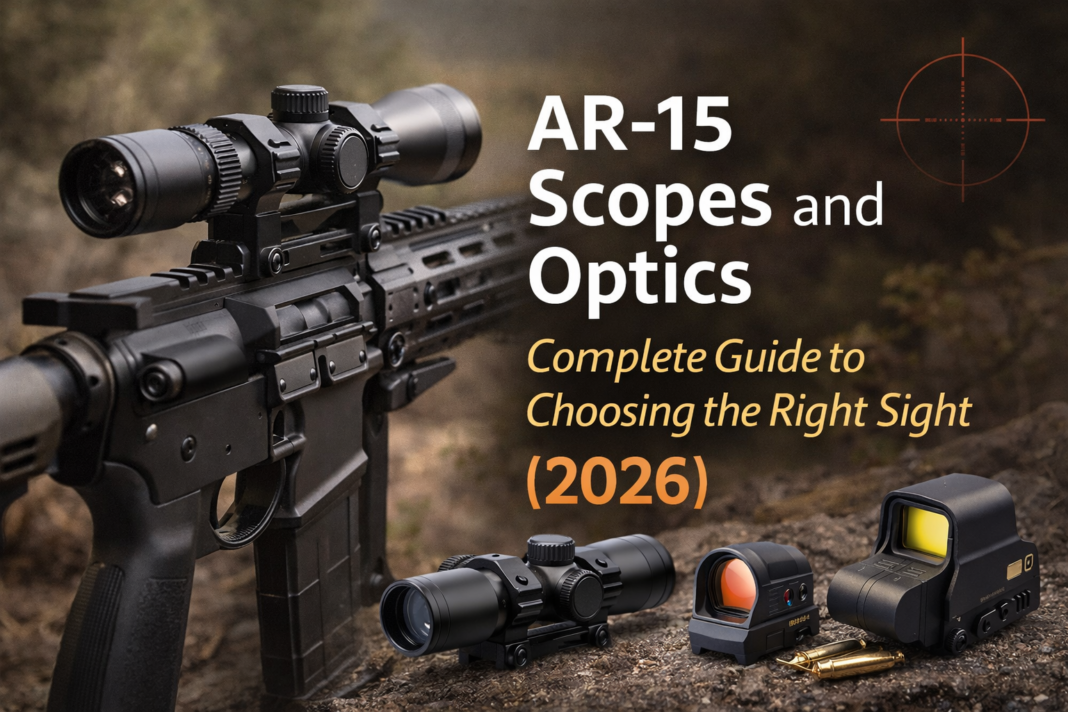

Looking for quality AR-15 optics? Check out Ozark Armament’s AR-15 optics selection for reliable red dots, scopes, and sighting solutions built for performance.
Selecting the right optic for your AR-15 represents one of the most impactful upgrades you can make to your rifle. The right scope or red dot transforms your shooting experience, improving accuracy, target acquisition speed, and effective range. With hundreds of options available in 2026—from budget red dots to premium magnified optics—understanding the landscape helps you make informed decisions that match your shooting style, intended applications, and budget.
Understanding AR-15 Optic Categories
The AR-15 optics market offers several distinct categories, each designed for specific applications:
Red Dot Sights
Red dot sights project an illuminated aiming point onto a lens, allowing shooters to keep both eyes open while acquiring targets quickly. These non-magnified optics excel at close to medium ranges, typically from contact distance to 200-300 yards.
Reflex Sights: Open emitter designs without tube housings offer unlimited eye relief and extremely fast target acquisition. Popular for competition shooting, home defense, and dynamic applications where speed matters most.
Tube-Style Red Dots: Enclosed in protective housings similar to traditional scopes, tube red dots provide better protection for the emitter and often include more mounting options. They’re popular for duty use and general-purpose applications.
Holographic Sights: Using laser technology to project reticles onto holographic film, these sights offer wide fields of view and maintain accuracy even if the viewing window is partially obstructed. They’re favored for close-quarters applications and professional use.
Low Power Variable Optics (LPVOs)
LPVOs typically range from 1-4x, 1-6x, 1-8x, or 1-10x magnification, combining red dot-style performance at 1x with the ability to magnify for precision shots at extended ranges. These versatile optics have become increasingly popular as “do-everything” solutions.
1-4x Scopes: Compact, lightweight options that balance close-range speed with moderate magnification for shots to 300-400 yards. Excellent for three-gun competition and general tactical applications.
1-6x and 1-8x Scopes: The sweet spot for many shooters, offering enough magnification for 500+ yard shots while maintaining usable 1x performance. Popular for hunting, competition, and versatile tactical use.
1-10x Scopes: Maximum versatility with extended range capability pushing toward 600-700 yards. Typically larger and heavier than lower magnification options.
Fixed Magnification Scopes
Traditional rifle scopes with set magnification levels—commonly 3x, 4x, or 5x for AR-15 applications. These optics offer simplicity, reliability, and often superior glass quality at their price points compared to variable designs.
Advantages: Fewer moving parts, lighter weight than comparable variables, often better optical clarity, simpler operation under stress.
Limitations: No flexibility to adjust magnification for different shooting scenarios or target distances.
High Magnification Scopes
For precision shooting, long-range applications, and situations requiring detailed target identification beyond 500 yards, higher magnification scopes ranging from 3-9x up to 6-24x or beyond serve dedicated purposes.
Mid-Range Variables (3-9x, 2.5-10x): Classic hunting and precision configurations that work well for AR-15 platforms in 5.56/.223, 6.5 Grendel, or other intermediate cartridges.
Long-Range Scopes (4-16x, 5-25x, and beyond): Designed for precision rifle applications, long-range competition, and maximum magnification for target identification and engagement at extended distances.
Magnifiers
Flip-to-side or slide-to-side magnifiers pair with red dot sights, providing 3x, 5x, or 6x magnification when needed while maintaining red dot speed for close work. This combination offers modularity and versatility.
Key Features to Consider When Choosing AR-15 Optics
Understanding technical specifications helps you evaluate options effectively:
Reticle Design
Dot Size: Measured in MOA (minutes of angle), common sizes include 2 MOA (precise aiming, covers less target), 3-4 MOA (general purpose balance), and 6+ MOA (fast acquisition, less precise). Smaller dots suit precision shooting; larger dots favor speed.
Reticle Complexity: Simple dot or crosshair designs offer uncluttered sight pictures and fast acquisition. BDC (bullet drop compensating) reticles with holdover marks assist with range estimation and elevation holds. Mil-dot and similar tactical reticles support advanced ranging and wind calling.
Illumination: Adjustable brightness settings allow visibility across lighting conditions. Quality optics offer settings bright enough for direct sunlight and dim enough for night vision compatibility. Some include auto-off features to preserve battery life.
First Focal Plane vs. Second Focal Plane: In FFP scopes, reticles grow and shrink with magnification changes, maintaining accurate subtension at all powers—critical for ranging and holdovers. SFP reticles remain the same size regardless of magnification, appearing clearer at low power but only providing accurate measurements at specific magnification.
Optical Quality
Lens Coatings: Multiple layers of anti-reflective coatings improve light transmission, reduce glare, and enhance clarity. Terms like “fully multi-coated” indicate quality coating application across all air-to-glass surfaces.
Glass Quality: Premium ED (extra-low dispersion) glass reduces chromatic aberration and improves color accuracy and sharpness, particularly at higher magnifications and in challenging light.
Eye Relief: The distance from your eye to the scope’s ocular lens where you maintain a full sight picture. Generous eye relief (3.5-4 inches) prevents scope strikes during recoil and allows comfortable shooting positions.
Field of View: How much area you see through the optic at given distances. Wider fields of view help maintain situational awareness and track moving targets.
Durability and Construction
Housing Material: Aircraft-grade aluminum provides the standard for quality optics—strong, lightweight, and corrosion-resistant. Some manufacturers use titanium or advanced alloys for enhanced strength.
Waterproofing: O-ring seals and nitrogen or argon purging prevent moisture infiltration and internal fogging. IPX ratings indicate water resistance levels.
Shock Resistance: Quality optics withstand repeated recoil, impacts, and rough handling without losing zero or suffering damage. Lifetime warranties often indicate manufacturer confidence in durability.
Mounting Interface: Most AR-15 optics use Picatinny rail mounts. Some include integrated quick-detach (QD) systems; others require separate mounting solutions.
Battery Life and Power
Battery Type: Common options include CR2032 coin cells, AA/AAA batteries, and specialized lithium cells. Standard battery types offer convenient replacement availability.
Runtime: Quality red dots now offer 50,000+ hour battery life (5+ years of continuous use). Variable optics with illumination typically provide hundreds to thousands of hours depending on brightness settings.
Auto-Off and Motion Activation: Advanced features that preserve battery life by shutting down after periods of inactivity or activating when movement is detected.
Battery Placement: Top-loading batteries allow changes without removing the optic or losing zero. Side-loading designs may require remounting.
Weight and Size
Overall Weight: Optic weight affects rifle balance, fatigue during extended use, and overall handling characteristics. Lightweight options (under 1 pound) maintain rifle agility; heavier scopes (1.5-2+ pounds) provide more features but reduce maneuverability.
Length: Compact optics preserve rail space for accessories and backup sights. Longer scopes may require specific mounting positions to achieve proper eye relief and balance.
Tube Diameter: Standard 1-inch tubes offer compact size; 30mm tubes provide more internal adjustment range and often better light transmission; 34mm and larger tubes maximize adjustment and optical performance in premium optics.
Selecting Optics for Specific AR-15 Applications
Different shooting disciplines and uses prioritize different optical characteristics:
Home Defense and Close Quarters
Ideal Optics: Tube or reflex red dots, holographic sights, or 1x prism sights
Key Features: Fast target acquisition, both-eyes-open shooting capability, minimal magnification, durable and reliable operation, simple controls accessible under stress
Considerations: Battery reliability is critical—choose optics with long runtime or always-on capability. Consider backup iron sights for redundancy.
Three-Gun and Competition
Ideal Optics: Low power variables (1-6x or 1-8x), red dots with magnifiers, or specialized competition red dots
Key Features: True 1x performance for close targets, enough magnification for distance stages, lightweight construction, wide field of view, daylight-bright illumination
Considerations: Speed of magnification changes (throw lever upgrades), reticle design supporting quick ranging, and reliable zero retention through transportation and stage movement.
Hunting
Ideal Optics: 1-6x or 1-8x LPVOs, 3-9x variables, or fixed 4x scopes depending on terrain and typical engagement distances
Key Features: Sufficient magnification for ethical shot placement at expected ranges, good low-light performance for dawn/dusk hunting, reticle visible against varied backgrounds, weather resistance
Considerations: Weight for all-day carrying, magnification range matching your hunting environment (thicker cover favors lower power, open country benefits from higher magnification), and illuminated reticles for low-light shooting windows.
Tactical and Duty Use
Ideal Optics: Tube red dots with proven durability, holographic sights, or 1-6x LPVOs for versatile capability
Key Features: Bomb-proof reliability, tested performance under extreme conditions, long battery life or replaceable under stress, night vision compatibility, proven zero retention
Considerations: Manufacturer reputation and warranty support, compatibility with existing accessories and night vision equipment, and documented reliability testing.
Precision and Long-Range Shooting
Ideal Optics: Higher magnification variables (4-16x, 5-25x) with FFP reticles and exposed turrets for dialing adjustments
Key Features: High magnification for target identification and precise aiming, FFP reticles for ranging and holdovers at any magnification, repeatable and trackable turrets, parallax adjustment, excellent glass quality
Considerations: Scope weight and size, reticle design matching your ballistic needs (Mil or MOA), turret design for dialing vs. holding corrections, and zero stop features.
General Purpose and Plinking
Ideal Optics: Budget-friendly red dots, basic 1-4x or 1-6x scopes, or quality entry-level optics from reputable manufacturers
Key Features: Adequate durability for recreational use, clear sight picture, holds zero through normal shooting sessions, reasonable battery life
Considerations: Balance cost with quality—extremely cheap optics frustrate more than help. Ozark Armament offers reliable entry-level optics that provide solid performance without premium pricing, making them excellent choices for recreational shooters and first-time optic buyers.
Mounting Your AR-15 Optic Properly
Proper mounting ensures optimal performance and maintains zero:
Choosing Mount Height
Lower 1/3 Co-Witness: Positions the optic so iron sights appear in the lower third of the viewing window. Offers lower mounting for natural head position while maintaining backup sight access.
Absolute Co-Witness: Aligns the optic with iron sights perfectly centered in the view. Provides lowest mounting but backup sights are more visually intrusive.
2.26″ High Mounts: Positions optics at an elevated height favored by many shooters using night vision, allowing more comfortable head position and clearance for passive aiming devices.
Scope Rings/Mounts: Traditional scopes require appropriate ring height to position the optic’s center line at comfortable eye level while providing objective lens clearance over the barrel/rail.
Installation Best Practices
Clean All Surfaces: Remove any oil, debris, or residue from rail surfaces and mounting hardware before installation. Clean mounting surfaces ensure secure attachment.
Even Tightening: Tighten mounting screws in a cross-pattern, gradually increasing torque evenly. This prevents canting and stress on the optic housing.
Proper Torque: Follow manufacturer specifications—typically 15-20 inch-pounds for ring screws, 30-65 inch-pounds for mount bases. Use a torque wrench for precision; over-tightening can damage components.
Thread Locker: Blue (medium-strength) thread locker on mounting screws prevents loosening from vibration while allowing future removal. Avoid red (permanent) thread locker on optic mounting.
Level Installation: Ensure the optic is level with the rifle’s bore. Canted optics create point-of-impact shifts that change with distance.
Zeroing Your Optic
Start Close: Begin zeroing at 25 yards to get on paper safely, confirming basic function before moving to your intended zero distance.
Choose Zero Distance: Common AR-15 zeros include 25-yard (close-range focus), 50-yard (practical general purpose), 100-yard (traditional rifle zero), and 200-yard (maximizes point-blank range for 5.56).
Establish Groups: Fire 3-5 shot groups from a stable rest, allowing barrel cooling between strings. Assess group centers rather than individual shots.
Make Adjustments: Follow your optic’s click values (typically 1/2 or 1/4 MOA per click for scopes, 1 MOA for many red dots). Most AR-15 scopes and red dots move point of impact in the direction you turn the turret.
Confirm and Document: After achieving satisfactory zero, shoot additional confirmation groups. Record your zero distance, ammunition type, and environmental conditions.
Red Dot vs. Magnified Optic: Making the Choice
Understanding when each optic type serves best helps match equipment to mission:
When Red Dots Excel
- Close-range focus from 0-200 yards where magnification isn’t needed
- Speed-critical applications like home defense, competition, or dynamic shooting
- Both-eyes-open shooting that maintains peripheral awareness
- Lightweight builds where minimizing weight is prioritized
- Budget constraints allowing quality red dots at lower cost than quality magnified optics
When Magnification Matters
- Extended ranges beyond 300 yards where target identification and precise aiming require magnification
- Precision shooting where small groups and exact point-of-aim matter
- Hunting applications requiring ethical shot placement at varied distances
- Target identification in tactical scenarios where distinguishing threats from non-threats requires detailed observation
- Versatile use cases where a single rifle serves multiple roles from close to extended range
The LPVO Compromise
Low power variable optics attempt bridging both worlds—1x performance approximating red dots with magnification capability for distance work. Modern LPVOs have improved dramatically, with true 1x (no magnification) designs offering impressive red dot-like performance while providing 6-8x magnification for precision shots.
LPVO Advantages: Single optic solution, no flip mechanisms or batteries beyond illumination, proven durability, versatile capability
LPVO Compromises: Heavier and bulkier than red dots, more expensive than red dots, 1x performance still slightly slower than dedicated red dots for some shooters, more complex operation under stress
Optic Maintenance and Care
Protecting your investment ensures long-term performance:
Regular Cleaning
Lens Care: Use microfiber cloths or lens pens specifically designed for optics. Avoid clothing, paper towels, or abrasive materials that scratch coatings. Remove dust with air bulbs before wiping to prevent grinding particles into glass.
Housing Cleaning: Wipe exterior surfaces with appropriate solvents to remove carbon, oil, and debris. Avoid getting solvents into turret assemblies or battery compartments.
Inspection: Regularly check mounting hardware for tightness, verify reticle illumination functions properly, ensure batteries maintain adequate charge, and confirm no moisture inside the optic.
Protection Strategies
Lens Covers: Flip-up or slide-off covers protect objective and ocular lenses from scratches, impacts, and debris when not shooting. Remove before use to avoid obstructed sight pictures.
Scope Coats: Neoprene or similar protective covers shield optics during transport and storage while providing additional impact protection.
Proper Storage: Store rifles with optics in cases or racks that prevent impacts to the scope. Avoid leaning rifles against walls or surfaces where they can fall.
Battery Management
Regular Replacement: Change batteries before they fail, particularly before important hunts, matches, or courses. Many shooters replace batteries annually regardless of remaining charge.
Spare Batteries: Keep extras in your range bag, vehicle, or attached to your rifle for field replacement capability.
Remove for Storage: For long-term storage, remove batteries to prevent corrosion from leaking cells.
Common AR-15 Optic Mistakes to Avoid
Learning from others’ errors saves time, money, and frustration:
Buying the Cheapest Option: Extremely low-cost optics from unknown manufacturers typically fail quickly, don’t hold zero, and create more problems than they solve. Invest in reputable brands even at entry-level price points.
Ignoring Mount Quality: Pairing quality optics with cheap mounts creates weak links that cause zero loss and potential optic damage. Mount quality matters as much as optic quality.
Wrong Magnification for Application: Buying high magnification for close-range use or red dots for long-range precision creates frustration. Match magnification to realistic engagement distances.
Poor Installation: Rushed mounting without proper torque, leveling, or preparation leads to shifting zero and unreliable performance.
Neglecting Backup Sights: For defensive rifles, having no backup aiming system creates single points of failure. Budget some rail space and funds for quality backup iron sights.
Not Training with Your Optic: Buying advanced optics without understanding their features, practicing ranging techniques, or developing skills wastes their potential.
Budget Considerations and Value
AR-15 optics range from under $100 to several thousand dollars. Understanding value at different price points helps maximize your investment:
Entry Level ($100-$300)
Quality entry-level optics from established manufacturers provide reliable performance for recreational shooting, basic home defense, and learning applications. Ozark Armament offers solid options in this range that deliver dependable function without premium pricing.
Expectations: Basic durability for normal use, adequate clarity, holds zero through standard shooting, limited warranty coverage
Best For: First optics, recreational shooters, budget builds, learning platforms
Mid-Range ($300-$800)
This range offers significantly improved glass quality, better durability, enhanced features, and stronger warranties. Sweet spot for serious recreational shooters and many professional applications.
Expectations: Very good optical clarity, proven durability, reliable performance across conditions, solid warranty support, advanced features like better illumination and reticle options
Best For: Serious hobbyists, competition shooters, hunting applications, duty use for many agencies
Premium ($800-$2000+)
Top-tier optics delivering exceptional optical quality, bomb-proof construction, advanced features, and lifetime warranties. Diminishing returns kick in, but professionals and dedicated enthusiasts appreciate the performance edge.
Expectations: Excellent glass quality approaching alpha-class, extreme durability, cutting-edge features, comprehensive warranty coverage, often night vision compatible
Best For: Professional use, serious competitors, dedicated long-range shooters, users who demand maximum capability
The Bottom Line on AR-15 Scopes and Optics
Selecting the right optic for your AR-15 transforms your rifle’s capability and your shooting experience. Whether you choose a fast-acquisition red dot, versatile low power variable, or precision long-range scope, understanding your actual use cases, budget parameters, and feature priorities ensures you invest wisely.
Quality optics from reputable manufacturers deliver reliable performance that enhances your shooting rather than creating frustration. While premium options offer measurable benefits, excellent value exists at every price point for shooters who research carefully and choose appropriately.
Ready to upgrade your AR-15 with quality optics?Explore Ozark Armament’s scope and red dot selection for reliable sighting solutions that combine solid construction with practical performance at accessible price points.
Take time to research, understand your needs, test options when possible, and invest in quality mounting. Your optic represents one of the most important components on your rifle—choose wisely, mount properly, train consistently, and enjoy the improved performance quality optics deliver.