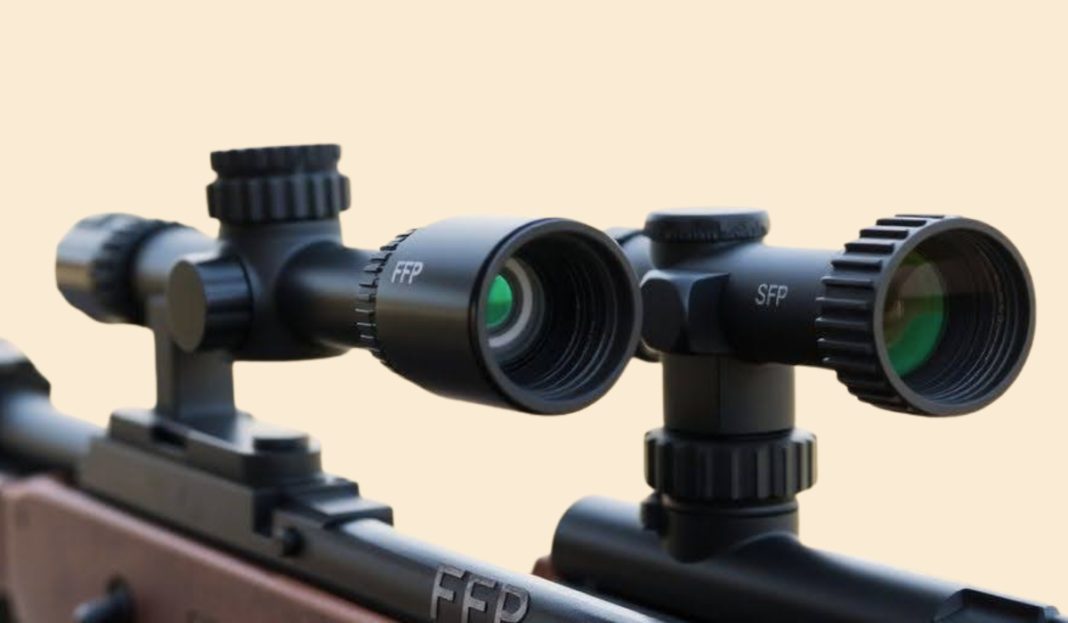

For competitive shooters, the choice of optics can be the difference between winning and merely participating. First Focal Plane (FFP) scopes have become increasingly popular among enthusiasts and professionals because they offer precision at any magnification. Understanding the features of an FFP rifle scope, and how it differs from other optics, is essential for anyone serious about improving performance in competition shooting. This guide will cover the core characteristics, advantages, and practical tips for choosing a high-quality competition shooting scope, while highlighting the role of modern precision optics in elevating accuracy.
An FFP rifle scope places the reticle in the front focal plane, meaning that as you adjust magnification, the reticle scales proportionally with the target. This is different from second focal plane optics, where the reticle remains the same size regardless of magnification. The FFP design allows shooters to make precise holdovers and range estimations at any zoom level, which is particularly valuable in precision optics applications such as long-range target competitions or tactical matches. Shooters who rely on rapid, accurate adjustments during competitive rounds often prefer FFP scopes because they can trust their reticle subtensions to remain true at all settings.
When evaluating an FFP rifle scope, one of the first factors to consider is magnification range. High magnification allows precise targeting at long distances, while lower magnification provides a wider field of view for tracking moving targets. Modern FFP scopes offer versatile ranges, such as 4-16x, 6-24x, or even 8-32x, providing competitive shooters with flexibility for various courses of fire. Choosing a magnification range depends on the specific type of competition shooting you participate in, as well as personal preference for reticle clarity and eye relief.
Another essential feature is the reticle itself. An FFP rifle scope may include illuminated options, fine hash marks, and subtension lines calibrated for specific calibers or ballistic profiles. These features allow shooters to quickly calculate bullet drop and windage without manual adjustments, which is critical in timed or dynamic shooting scenarios. Precision shooting becomes more reliable when the reticle matches the ammunition and distance, reducing guesswork and enhancing consistency. High-quality competition shooting scopes also incorporate advanced coatings to improve contrast, light transmission, and clarity, ensuring the target remains visible even in low-light conditions.
Durability and build quality are critical considerations. Scopes used in competitive settings often endure heavy handling, frequent adjustments, and varying environmental conditions. Rugged housings, shockproof construction, and waterproofing are essential features to look for in an FFP scope. Precision optics that maintain zero under recoil and remain consistent after repeated use give shooters confidence, whether on a 100-yard bench or in long-range steel matches. Many competitive optics now also include low-profile turrets for quick adjustments without removing your eye from the stock.
The table below illustrates some key differences and considerations when comparing FFP scopes to standard second focal plane (SFP) scopes for competition:
| Feature | FFP Rifle Scope | SFP Scope |
| Reticle Scaling | Changes size with magnification | Constant size at all magnifications |
| Holdover Accuracy | Accurate at all zoom levels | Only accurate at one specific magnification |
| Ideal Use | Long-range precision, dynamic competitions | General target shooting, hunting |
| Eye Relief | Often consistent across zoom | Consistent, but reticle subtensions vary |
| Adjustments | Fine-tuned for rapid range correction | Best for fixed distance shooting |
| Cost | Typically higher | Often lower, entry-level options available |
| Advantages | True holdovers, versatile | Simpler, easier to read at one magnification |
| Drawbacks | Slight learning curve, more expensive | Cannot scale reticle for all distances |
Choosing an FFP scope also involves understanding how your precision optics interact with your rifle and ammunition. Different calibers and velocities influence how bullet drop is calculated, so selecting a scope with a reticle suited for your ballistic profile is crucial. Many FFP scopes now include multi-calibrated reticles that account for commonly used cartridges, making it easier for shooters to adjust to different competition formats without recalibrating extensively.
Mounting and setup are equally important. Competitive shooters often pair FFP optics with high-quality rings, proper torque specifications, and stable bases. Even the most advanced scope will underperform if it is improperly mounted, misaligned, or subjected to uneven pressure. Careful attention to setup ensures that your FFP scope maintains zero and delivers repeatable accuracy, critical for success in competitive shooting events.
Practical air rifle tuning or firearm adjustments may complement your optic choice. Ensuring the rifle itself is performing consistently allows your FFP scope to function at its maximum potential. Consistent muzzle velocity, clean barrel, and stable recoil patterns reduce variables that can interfere with precise shot placement. For competition shooting, these combined factors make the difference between tight groups and unpredictable spreads.
Modern FFP scopes often include features designed specifically for competitive shooters. These include zero-stop turrets for quick reset to baseline elevation, parallax adjustment for precise targeting at various distances, and high-quality lens coatings for improved contrast. Shooters may also benefit from adjustable illumination levels on reticles, enabling accurate aiming in both bright sunlight and low-light conditions. Choosing an optic with these features ensures that your investment in precision optics translates to measurable performance improvements.
Environmental conditions play a significant role in competition. Wind, light, and terrain all influence shot placement. FFP scopes with precise subtensions allow shooters to compensate for wind drift, bullet drop, and even environmental effects with confidence. Unlike SFP scopes, FFP reticles remain accurate across magnification settings, making it easier to apply corrections on-the-fly during timed stages. For dynamic competitions where speed and accuracy must coexist, this advantage is invaluable.
Cost is another consideration. While FFP rifle scopes are generally more expensive than standard scopes, the investment pays off in performance. For competitive shooters, the ability to trust your reticle for holdovers at all magnifications can save time and reduce errors during critical moments. Entry-level SFP scopes may suffice for casual practice, but for serious matches or long-range precision, FFP scopes offer capabilities that are unmatched in versatility and consistency.
In summary, understanding the features of FFP scopes is essential for anyone serious about competition shooting. Key aspects include magnification range, reticle design, eye relief, adjustments, durability, and compatibility with your rifle and ammunition. Choosing a high-quality competition shooting scope with reliable precision optics ensures that your equipment will enhance performance rather than limit it.
Whether you are new to competitive shooting or an experienced marksman, investing in an FFP rifle scope provides measurable benefits. True holdover accuracy, versatile reticle scaling, and durable construction give shooters the confidence to engage targets effectively under a variety of conditions. Proper setup, careful attention to adjustments, and understanding the unique advantages of FFP design allow you to maximize performance and enjoy the process of refining your craft.
By combining an FFP rifle scope with proper rifle setup and ammunition selection, shooters can achieve repeatable results, tighter groups, and faster engagement times. For anyone seeking to elevate their competitive shooting performance, FFP optics represent a worthwhile investment and a key tool in mastering precision at all ranges.