
When it comes to the best month to See Northern Lights, the very best month is hotly disputed among travelers and skywatchers alike. The aurora borealis can be visible any time in winter, but many scientists concur that northern lights in March are the best because geomagnetic activity is at its highest and the nights are usually cloud-free.
This time of year, natural phenomena all come together to generate more frequent and powerful auroras. So if you are keen on taking a northern lights trip and want to know why March is the best month to see them, this might help you to find the right moment for your trip.
What Are the Northern Lights?
The northern lights, or Aurora Borealis is a colorful night sky light that can be seen near the Earth’s poles.
The lights are produced when the charged particles released from the sun travel into space and enter Earth’s magnetic field. As these particles collide with atmospheric gases, they produce gorgeous, glowing colors such as:
- Green
- Purple
- Pink
- Red
- Blue
This atmospheric phenomenon is one of the most incredible sky events that occur on Earth and draws thousands of travelers annually. Best Month to See Northern Lights.
Why March Is the Best Month to See Northern Lights
Northern lights are due to high geomagnetic activity, which peaks around the spring equinox, making March the best month to see northern lights, many scientists say.
The reasons for this are not entirely clear, but research over the years has shown that March has more days with geomagnetic activity than almost any month of the year. Indeed, March, which is the start of spring for the northern hemisphere, typically has about 6 days of strong geomagnetic activity on Earth compared to just a day or two during winter months like December.
The increased activity increases how often the auroras will appear and how bright and dramatic they will be.
The Russell – McPherron Effect Explained
The scientific explanation behind the northern lights being greater in March than any other month has to do with the Russell – McPherron Effect.
This idea was first proposed in 1973 by geophysicists Christopher Russell and Robert McPherron. This illustrates how the alignment of Earth’s and Sun’s magnetic fields drives aurora.
Usually, the magnetic field of Earth will redirect most of the solar wind away from the Earth. But at the equinoxes of spring and autumn, the alignment of Earth changes such that more solar wind can enter the magnetosphere.
This means that a greater number of charged particles collide with the atmosphere, resulting in more potent auroras. This is one of the main reasons March is considered the ideal Best Month to see Northern Lights.
Role of the Spring Equinox
Another key player in aurora watching is the spring equinox, which typically happens near the March 20 date.
During this time:
- Regular day and night are approximately identical around the globe
- Earth has a better-arranged magnetic field that can better align with solar wind
- Geomagnetic disturbances increase
When this happens, solar particles can more directly interact with Earth’s atmosphere, creating more intense and more frequent aurora displays.
It makes it one of the best months to see Northern Lights of the year for skywatchers and photographers to catch one of the most beautiful natural light displays.
Read more: Northern Lights Finland | Northern Lights Scotland
March Northern Lights season, what is the best hour at night?
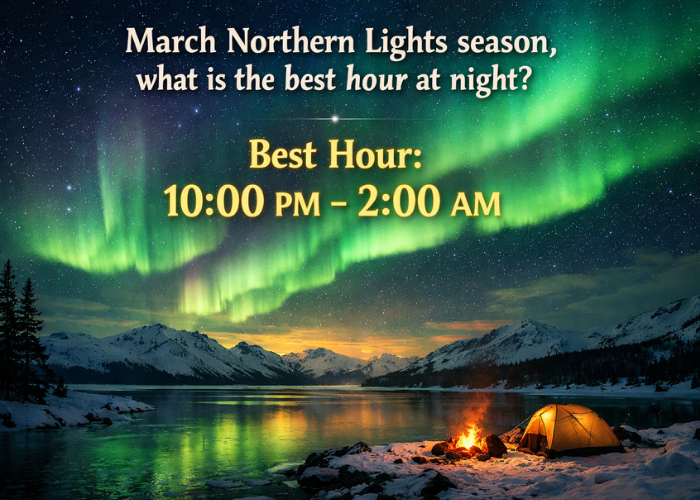
Although March is the Best Month to See Northern Lights, timing is also important at night.
The best time to catch it is generally:
| Time Period | Aurora Visibility |
| 6 PM – 9 PM | Low to moderate chances |
| 9 PM – 12 AM | Good viewing chances |
| 12 AM – 3 AM | Highest aurora activity |
| After 3 AM | Activity slowly decreases |
Because geomagnetic activity peaks around midnight hours, the best auroras typically happen between 9 p.m. and 3 a.m.
Top Spots to See the Northern Lights

The ultimate northern lights experience requires visiting areas right up near the Arctic Circle.
The best places to go are:
- Iceland
- Norway (Tromsø)
- Finland (Lapland)
- Sweden (Abisko)
- Alaska (USA)
- Northern Canada
These areas benefit from dark-sky and lie within the Auroral Oval, the zones in which the northern lights are most active.
Read more: Northern Lights Norway | Northern Lights Iceland
March Northern Lights Experience Viewing Guide – Tips
Here are some easy tips for improving your luck at the best month to see northern lights:
Choose Dark Locations
Stay away from city lights. Auroras can be detected much more readily in dark skies.
Check Aurora Forecasts
Keep an Eye on the Solar Activity with Aurora Forecast Websites or Apps
Be Patient
Auroras come and go, so you must be patient.
Dress Warmly
In northern climates, nights in mid-March are quite chilly.
Shoot with Slow Shutter Speed
Good aurora photos need a tripod and long exposure settings.
Aurora Activity Comparison: March vs other months
A comparison that demonstrates just how March is generally the Best Month to see Northern Lights.
| Month | Aurora Activity | Weather Conditions |
| December | Moderate | Long nights but cloudy weather |
| January | Moderate | Very cold and sometimes stormy |
| February | Good | Clear skies but slightly lower activity |
| March | Very High | Clear skies and strong geomagnetic activity |
| April | Good | Shorter nights |
It is this abysmal comparison that highlights the reasons so many aurora hunters choose to travel during the month of March.
Conclusion: Best Month to See Northern Lights
March is regarded as the best month to see northern lights for travellers, photographers, and astronomy enthusiasts alike. Added geomagnetic activity, clearer skies, and the spring equinox provide a perfect backdrop for the mystical aurora borealis.
If you go to Iceland or Norway, or northern Canada, March greatly improves your odds of witnessing this wonderful natural spectacle. If seeing the
Northern lights are on your bucket list, planning your trip during March might give you the most unforgettable view of the dancing lights in the sky.