
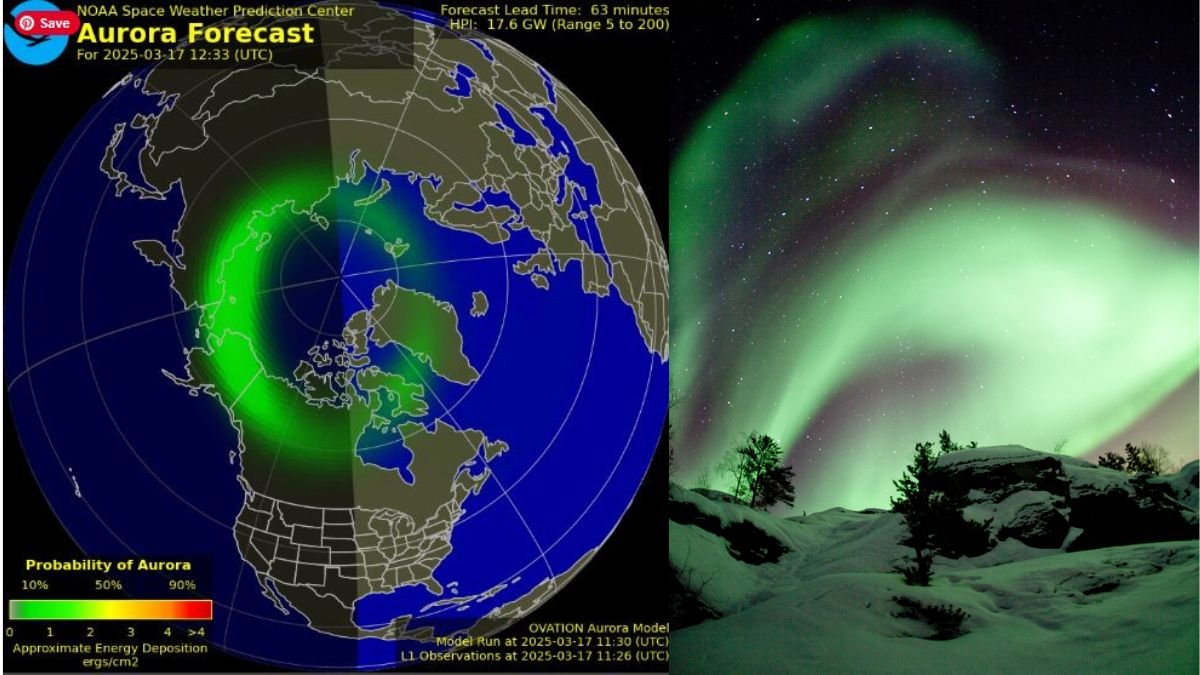
Tonight and Tomorrow Night (17 March to 19 March 2026), the Northern Lights Forecast is powered by real-time space weather data from NOAA and the Space Weather Prediction Center. This is a short-term forecast updated every 30 to 90 minutes based on the solar wind’s travel time from the L1 observation point to Earth (the two locations are some 1.49 million km apart).
The Forecast Tonight and Tomorrow Night guide is a way for skywatchers to plan accordingly and improve the odds of seeing the spectacular Aurora Borealis.
Steps to interpret the Northern Lights weather forecast: The highest KP index indicated haunts and greater chances of seeing the Northern Lights.
Moon phase: Waxing Gibbous
Aurora Forecaste (17 to 19 March 2026)
Aurora Borealis: forecast for March 17–19, 2026, at a glance (high latitude) Greenland, Canada, Alaska, Iceland, and Northern Siberia have the best chance to view the lights because of good geomagnetic conditions, the Weather Network said.
Northern Lights Forecast Canada
- Northern Newfoundland and Labrador
- Quebec
- Ontario
- Manitoba
- Saskatchewan
- Alberta
- British Columbia
- Yukon
- Northwest Territories
- Nunavut
Northern Lights Forecast USA
- Alaska
Northern Lights Denmark
- Greenland
Northern Lights Forecast Iceland
- Northern Iceland
Northern Lights Russia
- Northern Siberia
- Novaya Zemlya
- Severnaya Zemlya
- Franz Josef Land
Read more: Northern Lights Visible in Southern UK | Northern Lights Tonight
Northern Lights / Aurora 3-Day Forecast News
Northern Lights Viewing Schedule
- March 17, 2026 (Tuesday): Kp 3–4, Maximum visibility window: 12:00 to 03:00 am
- 18 March 2026 (Wed): Kp 3-4, again best seen midnight – 3:00 AM.
- 19 March 2026 (Thursday): Kp index between 2 and 3; best visible from midnight to 3:00 AM
Moon phase: Waxing Crescent
Aurora Borealis Prediction (March 07, 2026 to March 09, 2026)
Aurora Borealis (Northern Lights) at High Latitudes (07 March to 09 March 2026) Moderate (3 out of 9) The best views will be over Greenland, Northern Siberia, Alaska, and Canada.
Canada
- Northern Manitoba
- Northern Saskatchewan
- Northern Alberta
- Northern British Columbia
- Yukon
- Northwest Territories
- Nunavut
- Northern Quebec
United States
- Alaska
Denmark
- Greenland
Russia
- Northern Siberia
Northern Lights / Aurora 3-Day Forecast News
Northern Lights Viewing Schedule
March 07, 2026 (Saturday):
Midnight to 3:00 AM (UT) will be the best time to keep an eye out (when the Kp index is 1 to 3, so low to moderate aurora activity)
March 08, 2026 (Sunday):
Kp index should stay 2 to 3 at the high end or low end. October 20 offers a little bit better chances between 3:00 AM and 6:00 AM (UT) – and that’s the best we can do.
March 09, 2026 (Monday):
The Kp index can reach 3 – 4 on this day, giving you a better chance of seeing it. That said, chances to see the Northern Lights overall will likely still be limited given weather and sky conditions.
Moon Phase: Waxing Crescent 🌒
Northern Lights Forecast (04 March to 06 March 2026)
March 2026: The Aurora Borealis forecast for March 4 to 6, 2026, shows a moderate opportunity to see the Northern Lights at high latitudes. The best chances of seeing it will be in places like Northern Norway, Sweden, Finland, and Iceland.
If the weather stays good, we could see the Northern Lights much further south, too, possibly as far south as parts of Scotland and northern Germany, thanks to elevated geomagnetic activity.
Canada Northern Lights Forecast
- Yukon: 30 – 40%
- Northwest Territories: 30 – 40%
- Nunavut: 30 – 40%
- Northern Alberta: 30 – 40%
- Northern Saskatchewan: 10 – 20%
- Manitoba: 10 – 20%
- Northern Quebec: 10 – 20%
Alaska Northern Lights Forecast
- North Slope: 10 – 20%
- Point Hope: 10 – 20%
- Point Lay: 10 – 20%
- Utqiaġvik: 10 – 20%
- Nuiqsut: 10 – 20%
Denmark (Greenland) Northern Lights Forecast
- Vejle: 20 – 30%
- Ribe: 20 – 30%
- Aabenraa: 20 – 30%
- Odense: 20 – 30%
- Zealand: 20 – 30%
Russia Northern Lights Forecast
- Svalbard: 20 – 30%
- Franz Josef Land: 20 – 30%
- Severnaya Zemlya: 20 – 30%
- New Siberian Islands: 20 – 30%
- Wrangel Island: 20 – 30%
- Novaya Zemlya: 10 – 20%
Northern Lights / Aurora 3-Day Forecast News
- March 04, 2026 (Wednesday): Kp 2-5, best seen 11 PM to midnight.
- March 05, 2026 (Thursday): Most active period throughout the night with a Kp index of 5 from 2:00 AM to 8:00 AM, where Northern Lights can be best viewed.
- 06 March 2026 (Friday): The Kp index falls to about 2, making aurorae much less visible than earlier in the week.
Moon Phase: Last Quarter 🌗
Northern Lights Forecast (February 21st to February 23rd 2026)
However, Northern Lights activity projected by NOAA from Feb 21 to 23, 2026, is relatively mellow, with only a moderate chance of visibility.
Weak geomagnetic storms triggered by a possible coronal mass ejection (CME) around February 23 could permit the aurora to dip just a bit farther south than it might otherwise (extreme solar weather permitting). Overall, though, the trend in activity is forecast to remain fairly quiescent with no major geomagnetic outbursting events.
Canada Northern Lights Forecast
- Northwest Territories: 10 – 20%
- Nunavut: 10 – 20%
- Southampton Island: 10 – 20%
- Northern Quebec: 20 – 30%
- Iqaluit: 20 – 30%
- Saskatchewan: 20 – 30%
- Manitoba: 20 – 30%
- Ontario: 20 – 30%
Greenland Northern Lights Forecast
- Disko Bay: 10 – 20%
- Aasiaat: 10 – 20%
- Sisimiut: 10 – 20%
- Maniitsoq: 10 – 20%
- Nuuk (Godthab): 10 – 20%
- Kulusuk: 10 – 20%
- Ammassalik: 10 – 20%
Alaska Northern Lights
- North Slope: 20 – 30%
Russia Northern Lights
- Svalbard: 10 – 20%
- Franz Josef Land: 10 – 20%
- Severnaya Zemlya: 10 – 20%
- New Siberian Islands: 10 – 20%
Northern Lights Viewing Schedule
- Saturday, February 21, 2026: KP index 1 and 2 (best viewing is after 11:00 PM)
- Those dates are as follows: Sunday, February 22, 2026: Kp 1-2; Best viewed post-midnight
- February 23, 2026 (Monday): KP index of 2 and will be best seen at 2:00 AM.
Moon Phase: Waning Gibbous 🌖
Northern Lights Prediction (Feb 18to Feb 20, 2026)
Likelihood of sighting the Aurora Borealis is predicted to stay at a moderate level across the Northern Atlantic and both the Northern Arctic from Oct 2nd – Oct 4th in that period of time. NOAA predicts auroral activity will be low to moderate at most.
According to the Northern Lights Forecast (18 February to 20 February 2026), the best places to see this are in high-latitude areas like Canada, Alaska, northern Russia, and Denmark (Greenland). In ideal geomagnetic conditions, the aurora may even be seen a little further south.
Northern Lights Canada
- Yukon Territory: 40 – 50%
- Northwest Territories: 40 – 50%
- Nunavut: 40 – 50%
- Iqaluit: 40 – 50%
- Northern British Columbia: 40 – 50%
- Alberta: 30 – 40%
- Saskatchewan: 30 – 40%
- Manitoba: 30 – 40%
- Ontario: 30 – 40%
- Northern Quebec: 30 – 40%
Northern Lights Forecast Alaska
- North Slope: 20 – 30%
- Northwest Arctic: 20 – 30%
- Yukon-Koyukuk: 20 – 30%
Northern Lights Forecast Denmark (Greenland Region)
- Esbjerg: 10 – 20%
- Ribe: 10 – 20%
- Tønder: 10 – 20%
- Horsens: 10 – 20%
- Vejle: 10 – 20%
- Fredericia: 20 – 30%
- Kolding: 20 – 30%
- Haderslev: 20 – 30%
- Aabenraa: 20 – 30%
- Sønderborg: 20 – 30%
- Funen: 20 – 30%
- Copenhagen: 20 – 30%
- Lolland: 20 – 30%
Northern Lights Forecast Russia
- Svalbard: 10 – 20%
- Franz Josef Land: 10 – 20%
- Severnaya Zemlya: 10 – 20%
- New Siberian Islands: 10 – 20%
Northern Lights Viewing Schedule
- February 18, 2026 (Wednesday): Kp 2-4 and local maximum in the early morning hours
- The 19th of February 2026 (Thursday): Kp 2-3, Good time to see from Midnight till 2:00 GMT
- Feb 20, 2026 (Friday): Kp 3, best seen near midnight
Moon Phase: Full Moon 🌕
Northern Lights Forecast (Feb 13 – Feb 15 2026)
The Northern Lights Forecast (13 February 2026 to 15 February 2026) is showing moderate activity with the potential for minor geomagnetic substorms. NOAA said the first two days look like better bets, though truck traffic may diminish a little by the third day.
Cloud cover will be key with clear skies or low clouds regarding visibility.
Northern Lights Forecast Canada
- Yukon Territory: 45 – 50%
- Northwest Territories: 45 – 50%
- Nunavut: 45 – 50%
- Iqaluit: 45 – 50%
- Victoria Island: 45 – 50%
- Northern British Columbia: 40 – 50%
- Alberta: 40 – 50%
- Saskatchewan: 30 – 40%
- Manitoba: 30 – 40%
- Ontario: 30 – 40%
- Ungava Bay: 30 – 40%
- Quebec: 30 – 40%
Northern Lights Forecast Denmark
- Grenaa: 30 – 40%
- Aarhus: 30 – 40%
- Horsens: 30 – 40%
- Vejle: 30 – 40%
- Fredericia: 30 – 40%
- Kolding: 20 – 30%
- Esbjerg: 20 – 30%
- Ribe: 20 – 30%
- Haderslev: 20 – 30%
- Aabenraa: 20 – 30%
- Tønder: 10 – 20%
- Sønderborg: 10 – 20%
- Copenhagen: 10 – 20%
Northern Lights Forecast Alaska
- North Slope: 30 – 40%
- Yukon-Koyukuk: 30 – 40%
- Northwest Arctic: 30 – 40%
Northern Lights Forecast Russia
- Wrangel Island: 20 – 30%
- New Siberian Islands: 20 – 30%
- Severnaya Zemlya: 20 – 30%
- Franz Josef Land: 10 – 20%
- Novaya Zemlya: 10 – 20%
- Svalbard: 10 – 20%
Northern Lights Viewing Schedule
- Feb 13, 2026 (Friday): KP 3 to 4, 12 am – 2 am visible
- Saturday 14 February 2026 = Kp 5, the best aurora viewing day.
- February 15, 2026 (Sunday): Kp 2 to 4, peak time around midnight
Moon Phase: Waxing Gibbous 🌔
Aurora forecast (10-12 February 2026)
We see some moderate to high auroral activity on the Northern Lights forecast (10 February 2026 – 12 February 2026) across the northern hemisphere. Places like Alaska, Canada, Iceland, and Norway will yield the best odds of spotting this wonder.
Northern Lights Viewing Schedule
- Kp index of 3 5, the best time is in the morning (5 am), 10 February 2026
- February 11, 2026: Kp 3 to 4, (best visibility 3 a.m. to 4 a.m.)
- 12 Feb 2026 – KP 4 to 5, highest at 02:00h
Moon Phase: First Quarter 🌓
Aurora Watch (07 February to 09 February 2026)
The Northern Lights Forecast (07 February – 09 February 2026) features moderate-level auroral activity with minor substorms sporadically. The initial day gives at least, as you progress, visibility tends to fade slightly.
Northern Lights Viewing Schedule
- February 7, 2026: Kp index 1 to 4, most favorable at 2 AM
- February 8 2026: KP index 1-3 2 AM to dawn visible
- 02/09/2026: KP ~ 2 – Less likelihood for visibility
Moon Phase: Waxing Crescent 🌒
Northern Lights Forecast (04 February to 06 February 2026)
This means aurora activity during this time should be rather relaxed due to little disturbances of the geomagnetic field. Kp index remaining below 4, weak auroral activity
Northern Lights Viewing Schedule
- 02 February 2026: KP index 2- 4, after 20:00 is good visibility
- Moderate chances, Kp index 2- 3, 05 February 2026.
- 06 February 2026: Kp ~ 2, Ideal 2 AM viewing time.
Moon Phase: New Moon 🌑
Northern Lights Possibility (31 January to 02 February 2026)
The auroral activity mapping known as the Northern Lights Forecast (31 January to 02 February 2026) predicts a moderate level of auroral activity across the high-latitude regions of the Northern Hemisphere. Geomagnetic conditions are anticipated to be broadly settled with periodic minor storms, which means that the probabilities are much more favorable for seeing the Aurora Borealis where one normally wouldn’t, NOAA reported.
The Northern Lights will be most visible during this time in places that lie within or near the auroral oval. The best views will be in places like Canada, Alaska, sections of Russia, and Greenland. Aurora activity may dip to a few degrees further towards lower latitude under the right conditions.
Northern Lights Forecast Canada
- Northern Quebec: 30 – 40%
- Nunavut: 30 – 40%
- Ontario: 30 – 40%
- Manitoba: 30 – 40%
- Saskatchewan: 20 – 30%
- Northwest Territories: 20 – 30%
- Yukon: 20 – 30%
Northern Lights Forecast Greenland (Denmark)
- Southern Greenland: 20 – 30%
Northern Lights Forecast United States
- Northern Alaska: 10 – 20%
Northern Lights Forecast Russia
- Severnaya Zemlya: 20 – 30%
- Franz Josef Land: 20 – 30%
Northern Lights Forecast Norway
- Svalbard: 20 – 30%
Moon Phase: Waning Crescent 🌘
Northern Lights Forecast (27 January to 29 January 2026)
Northern Lights Forecast (27 January to 29 January 2026): Minor to Moderate Auroral Activity for High Latitudes Near the Arctic Circle. Aurora Borealis is usually seen in North Pole regions like Scandinavia, Canada, and Russia. These areas are located within the auroral oval, an area of the strongest geomagnetic activity.
Northern Lights Forecast Canada
- Yukon: 40 – 50%
- Northwest Territories: 40 – 50%
- Nunavut: 40 – 50%
- Iqaluit: 40 – 50%
- Baffin Island: 20 – 30%
- Northern British Columbia: 30 – 40%
- Northern Alberta: 30 – 40%
- Northern Saskatchewan: 30 – 40%
- Manitoba: 30 – 40%
- Northern Quebec: 20 – 30%
- Northern Ontario: 20 – 30%
- Newfoundland and Labrador: 20 – 30%
Northern Lights Forecast Alaska
- Northern Alaska: 30 – 40%
Northern Lights Forecast Russia
- Novaya Zemlya: 20 – 30%
- New Siberian Islands: 20 – 30%
- Severnaya Zemlya: 20 – 30%
- Franz Josef Land: 20 – 30%
Northern Lights Forecast Norway
- Svalbard: 20 – 30%
Northern Lights Viewing Schedule
- Jan 27: KP 1 to 3; The best viewing time will be at 02:00 (Tuesday)
- Kp: 1-2 28 January 2026 (Wednesday) 11:00 PM (Kp=0 over Southern Hemisphere)
- Jan 29/ 2026 (Thursday): Kp 1, less likely unless skies are exceptionally clear.
Moon Phase: Last Quarter 🌗
Northern Lights Possibilities & Forecast (January 23 – January 25, 2026)
NOAA Northern Lights Forecast (23 January to 25 January 2026) predicts moderately high geomagnetic activity with a preferred view direction to the north, covering a smaller region of Northern Europe and ashore within Russia proper.
Best Viewing Regions
- Northern Sweden
- Northern Norway
- Northern Finland
- Northern Russia
Northern Lights Forecast Canada
- Victoria Island: 10 – 20%
- Banks Island: 10 – 20%
- Ellesmere Island: 10 – 20%
- Baffin Island: 10 – 20%
- Iqaluit: 10 – 20%
Northern Lights Forecast Greenland
- Southern Greenland
Northern Lights Forecast Russia
- Franz Josef Land: 30 – 40%
- Novaya Zemlya: 30 – 40%
- Severnaya Zemlya: 20 – 30%
- New Siberian Islands
Northern Lights Viewing Schedule
- January 23, 2026 (Friday): Kp 1-2, 11 PM favorable
- Saturday 24 January 2026: Kp = 1 – 4, best seen between 17:00 and 23:00.
- KP about 4 with a peak around 02:00 AM (We.e. January 2026, Sunday, January 25th at 2:00 AM).
Aurora Forecast (January 20-22, 2025)
Northern Lights Forecast (20 January to 22 January 2026) – Moderate Aurora Activity. We may also have some auroras dancing above our heads in northern regions and on the horizon in slightly southern ones, provided the skies are dark.
Northern Lights Forecast Canada
- Yukon: 40 – 50%
- Northwest Territories: 40 – 50%
- Hudson Bay: 40 – 50%
- Southern Quebec: 40 – 45%
- British Columbia: 20 – 30%
- Alberta: 10 – 20%
- Saskatchewan: 20 – 30%
- Manitoba: 10 – 20%
Northern Lights Forecast Alaska
- Southern Alaska: 40 – 50%
Northern Lights Forecast Greenland
- Southern Greenland: 20 – 30%
Northern Lights Forecast Norway
- Svalbard: 20 – 30%
Northern Lights Viewing Schedule
- 20 January 2026 (Tuesday): KP index 2–3, best viewing at midnight.
- 21 January 2026 (Wednesday): KP index 1–3, early morning visibility.
- 22 January 2026 (Thursday): KP index around 2, best time at 2 AM.
Moon Phase: Waning Gibbous 🌖
Aurora Forecast (16 January to 18 January 2026)
Aurora Forecast: 80 (16 January to 18 January 2026) Moderate (North America). Geomagnetic conditions and cloud-free skies will govern its visibility.
Northern Lights Forecast Canada
- Yukon: 45 – 50%
- Northwest Territories: 45 – 50%
- Nunavut: 45 – 50%
- Hudson Bay: 40 – 50%
- Alberta: 20 – 30%
- Saskatchewan: 20 – 30%
- Manitoba: 20 – 30%
- Quebec: 20 – 30%
- Ontario: 10 – 20%
Northern Lights Forecast Alaska
- Alaska: 30 – 40%
Northern Lights Forecast Russia
- Franz Josef Land: 10 – 20%
- Novaya Zemlya: 10 – 20%
Northern Lights Viewing Schedule
- Jan 16 2026 (Fri): Kp 2-3
- Jan 17, 2026 (Sat): KP 0–2
- 18 Jan 2026 (Sun) Kp 2–3, local midnight maximum
Aurora Borealis – Centre map on 13th January 2026, 15th January 2026
The Northern Lights Forecast (Jan 13 – Jan 15, 2026) shows aurora activity is steady across the auroral oval
Northern Lights Forecast Canada
- Yukon: 40 – 50%
- Northwest Territories: 40 – 50%
- Nunavut: 40 – 50%
- British Columbia: 30 – 40%
- Alberta: 30 – 40%
Northern Lights Forecast Russia
- Franz Josef Land: 20 – 30%
- Novaya Zemlya: 20 – 30%
Northern Lights Forecast Alaska
- Alaska: 40 – 50%
Northern Lights Forecast (07 January to 09 January 2026)
Aurora alert from 07 of January till the 09 of January 2026 – The Northern Lights Forecast called from minor to moderate geomagnetic storms, which are important for aurora appearance.
Best Regions
- Canada
- Alaska
- Norway
- Russia
- Greenland
Northern Lights Viewing Schedule
- 07 Jan 2026: KP 1–4, Time 2 AM
- Kp 01 – 03, 08 January 2026, good one to moderate display.
- January 9Jan 2Kp index ~ 2 (less favorable)
According to NOAA, The best time to haunt these lights is between 10 p.m. and 2 a.m. local time, avoid city light pollution, and travel as far north as possible.
Also Read: Best Time to See Northern Lights In Alaska | Can You See The Northern Lights in Scotland? | Facts and Fiction About the Northern Lights